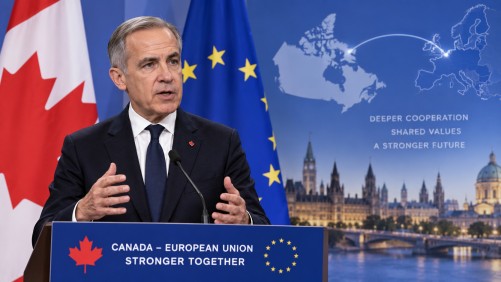
The European Union is exploring a new form of international partnership by proposing that Canada become its first associate member. This initiative, aimed at enhancing strategic resilience, comes as Canada and the EU seek to deepen their cooperation in critical sectors, including minerals, energy security, artificial intelligence, and digital trade.
Canadian Prime Minister Mark Carney, addressing the European Parliament in Strasbourg, expressed his support for the EU’s proposal. He highlighted the potential for stronger institutional and economic ties between Canada and Europe, emphasizing that the exact nature of this relationship would depend on ongoing discussions with European leaders. Although Canada is not pursuing full EU membership, it is keen on exploring closer cooperation.
European Commission President Ursula von der Leyen, who put forward the proposal, noted that a deeper partnership could elevate EU-Canada relations to a new level. The two parties already have several trade and sectoral agreements in place, but this new initiative could expand their collaboration to include areas like defense and space, as well as youth exchanges and participation in the EU’s Erasmus+ program.
While the concept of an EU associate membership is unprecedented and not currently defined within EU treaties, it has garnered support from several European countries. However, there are reservations within the bloc about the potential designation. The proposal’s announcement comes amidst increasing trade tensions involving the United States, Canada, and the EU. U.S. President Donald Trump has criticized the initiative, warning of possible tariffs if the relationship between Canada and the EU is significantly strengthened.