
The United Nations Security Council officially adopted a new resolution on Monday concerning the future of Gaza, but the victory in the chamber is overshadowed by a harsh reality on the ground. The plan, which was drafted by the United States and mirrors President Donald Trump’s 20-point strategy, is built upon a complex diplomatic trade-off that attempts to satisfy opposing sides with promises neither is willing to accept. At its core, the resolution offers a “pathway to statehood” as a political incentive for Palestinians, while simultaneously mandating the creation of an “International Stabilization Force” (ISF) to enforce security. This dual approach was intended to bridge the gap between security needs and political aspirations, yet it has immediately highlighted the immense chasm separating the warring parties, threatening the initiative’s viability before it even begins.
The political component of the resolution, specifically the clause outlining a conditional route to Palestinian statehood, was the linchpin that secured the necessary support from the Palestinian Authority. Diplomats involved in the high-stakes negotiations revealed that without this specific endorsement of statehood, the resolution would likely have faced a veto from Russia, halting the process entirely. However, this diplomatic victory in New York triggered an immediate and sharp rebuke from Jerusalem. Israeli Prime Minister Benjamin Netanyahu publicly and vocally reiterated his government’s staunch opposition to the creation of a Palestinian state, signaling that the “carrot” meant to entice cooperation is being fundamentally rejected by the very power that controls the territory’s borders.
On the other side of the equation lies the “security stick,” a robust mandate for an international force to enter Gaza, decommission all weaponry, and dismantle military infrastructure. This provision is designed to ensure that the enclave can no longer be used as a staging ground for attacks against Israel, a prerequisite for any reconstruction efforts. However, Hamas, the militant group currently in possession of these weapons, issued a defiant statement rejecting what they termed “international guardianship.” By vowing that they “will not disarm,” Hamas has set the stage for a direct physical confrontation with any future peacekeeping force, turning the resolution’s security roadmap into a potential battle plan.
Despite these glaring contradictions, the United States celebrated the resolution’s passage as a major triumph of international diplomacy. Ambassador Mike Waltz championed the plan as the only viable method to “dismantle Hamas’ grip” on the region and pave the way for a “prosperous and secure” Gaza. This optimism was echoed by President Trump, who is slated to chair a newly formed “Board of Peace” dedicated to overseeing the massive reconstruction efforts required. For the US delegation, the vote was “historic,” representing a decisive move toward ending the conflict, even if the mechanics of implementation remain fraught with peril.
However, the view from other global powers suggests a deep skepticism regarding the plan’s potential for success. The abstentions by Russia and China were not merely passive acts but active protests against a process they view as being monopolized by Washington. Russian Ambassador Vasily Nebenzya criticized the Security Council for essentially signing over “complete control” to a US-led initiative rather than a distinct UN operation. Consequently, the plan moves forward with no unified backing from the Security Council, a firm rejection from the militants in Gaza, and only reluctant, partial engagement from Israel, leaving the path to peace more treacherous than ever.
A House Divided: UN Resolution Passes Despite Rejection from Combatants
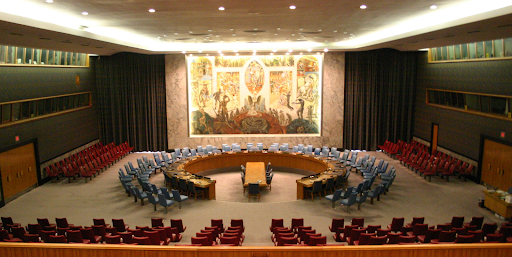
Picture credit: www.commons.wikimedia.org
15