
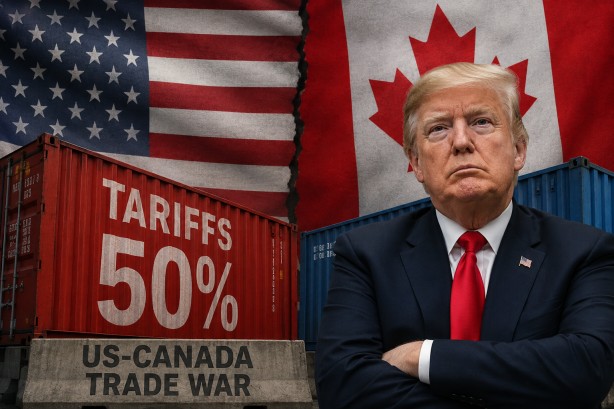
The trade tensions between the United States and Canada have intensified as President Donald Trump announced a significant increase in tariffs following stalled negotiations in Washington. The U.S. has decided to implement a 50% tariff on approximately $20 billion worth of Canadian imports, which include items such as hockey sticks and medical supplies. This move has prompted a swift response from Canadian Prime Minister Mark Carney, who stated that Canada would mirror these tariffs with equivalent measures on U.S. goods starting September 8.
Prime Minister Carney expressed strong opposition to the U.S.’s latest actions, labeling them as an attack on Canada’s economy. He emphasized that his administration would not bow to the demands that emerged during the recent negotiation attempts. On the other side, U.S. Trade Representative Jamieson Greer justified the imposition of tariffs, arguing that they are essential for safeguarding American workers and maintaining the integrity of supply chains.
This escalation casts uncertainty over the USMCA, the trade agreement that binds the United States, Canada, and Mexico. The agreement facilitates around $2 trillion in trade each year across the three nations, and the rising conflict threatens to undermine its stability.
Concerns are mounting regarding the potential economic repercussions of this trade battle. Higher costs for both businesses and consumers loom on the horizon if the dispute continues to deepen, potentially straining the longstanding economic ties between the neighboring countries.