
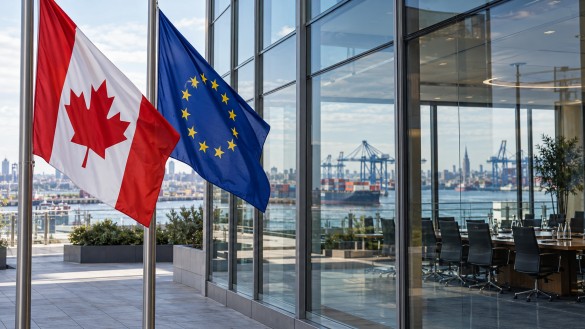
In a move to bolster economic security and strategic cooperation, Canada and the European Union have launched the Alliance for the Future. This new partnership, announced in Montreal by Canadian Prime Minister Mark Carney and European Commission President Ursula von der Leyen, aims to enhance trade, protect shared interests, and deepen cooperation amid escalating global uncertainties. The alliance remains open to nations that align with its values and goals.
The announcement follows a two-day summit where both leaders emphasized the importance of safeguarding democratic values and reducing vulnerabilities in global supply chains. With Canada’s ongoing efforts to diversify international partnerships, especially amid trade tensions with the United States and concerns over foreign technology dependence, this alliance represents a strategic pivot.
Among the key agreements from the summit, Canada pledged to support a €90 billion loan to Ukraine, while both parties discussed plans to create a more integrated economic market, reduce barriers to trade and travel, and expand educational exchanges. A significant aspect of the alliance is its focus on technology and artificial intelligence. An agreement was reached to allow Canadian researchers and companies access to Europe’s supercomputing network, enhancing AI model training capabilities.
The summit also highlighted potential corporate collaborations, including a planned merger between Canadian AI firm Cohere and Germany’s Aleph Alpha, which would establish joint headquarters in Toronto and Berlin. The Canadian government has proposed a potential investment of up to C$1.6 billion in Cohere, reflecting a commitment to reducing reliance on major foreign technology providers and securing critical resources like energy, minerals, and semiconductors.
Additionally, discussions touched upon the possibility of Canada becoming an associate member of the European Union. Von der Leyen noted this proposal as an opportunity to strengthen ties with a non-European nation, emphasizing that the partnership is not aimed against any other country. A more defined framework for this arrangement is expected by 2027.
While the summit faced political friction in Quebec, with Premier Paul St-Pierre Plamondon abstaining from attendance due to disagreements over provincial representation, the commitment to building a robust partnership focused on economic resilience and international cooperation remains unwavering. European Council President Antonio Costa praised the initiative, highlighting Canada’s political and cultural connections to Europe.